Summary:Struggling to find the perfect color match for your weft hair extensions? Follow these expert tips for seamless shade synchronization and hue blending!
Quick Terminology
- Weft: A track or curtain of hair attached to a fabric strip, forming the base of many hair extensions.
- Mid-lengths: The center portion of your hair strands, between the roots and the tips.
How Do I Find My True Hair Undertone?
Lighting is everything. To see your hair’s authentic colors and undertones, stand about 3 feet away from a window with indirect sunlight (a north-facing window is ideal) around midday. Avoid direct sun, which can wash out color.
Once in the right light, hold sections of your clean hair against a professional shade chart. Compare primarily at the root and mid-length areas, as ends can be lighter from sun or heat damage. This method prevents mismatches caused by artificial lighting.
Identify your dominant underlying tone:
- Warm: Golden or red undertones
- Cool: Ashy or platinum tones
- Neutral: A balanced mix of warm and cool
Why and How Should I Map My Hair’s Color Variations?
Mapping is crucial for precise extension tone alignment, as most natural hair isn’t just one flat color. You need to account for the differences between sections.
- Root color (your natural base)Root Color: Your natural base color.
- Mid-lengths: Often the truest representation of your overall color.
- Ends: Can be significantly lighter due to environmental exposure.
Color Match Checklist:
- I am in a room with plenty of indirect natural light.
- It is close to midday for the most accurate light.
- My hair is clean, dry, and free of heavy styling products.
- I have a physical or digital shade chart for comparison.
How Do I Use Your Professional Color Chart Effectively?
We offer a wide selection of over 40 bespoke shades to ensure you find your perfect match. View our Sunny Hair Digital Shade Chart for the most accurate representation.
For a natural, multi-toned appearance, we recommend blending 2-3 complementary shades. This creates depth and ensures a seamless blend with your own hair.
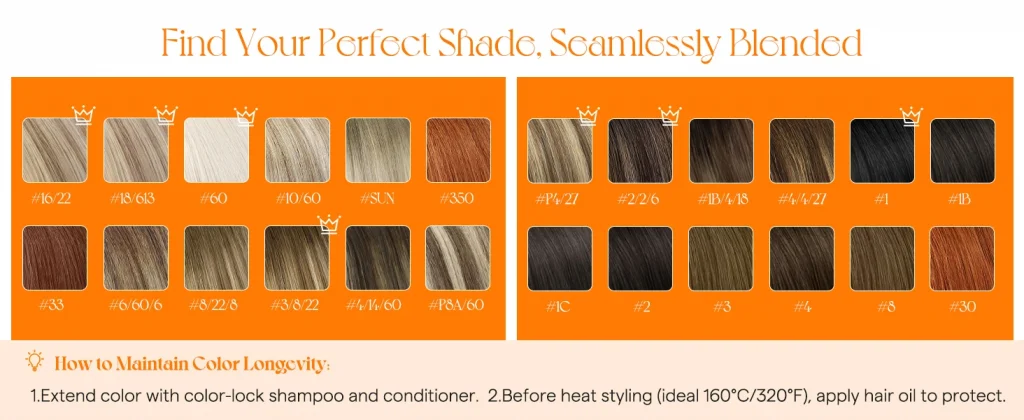
Quick Use-Case Examples:
- If your hair looks like… a solid, cool dark brown from root to tip, choose shade… a single match like “Espresso Ash.”
- If your hair looks like… dark roots with sun-lightened warm brown ends (common ombré), choose shade… a darker root shade (e.g., “Dark Chocolate”) blended with a lighter mid/end shade (e.g., “Caramel Brown”).
- If your hair looks like… rich, warm, brownish-red autumn tones (sometimes called “Maillard” tones), choose shade… a blend of auburn and chestnut shades.
FQA
Still need help?
We are here for you!
You can provide a picture of your hair in normal light without filters. We can provide you with more professional color matching needs.


